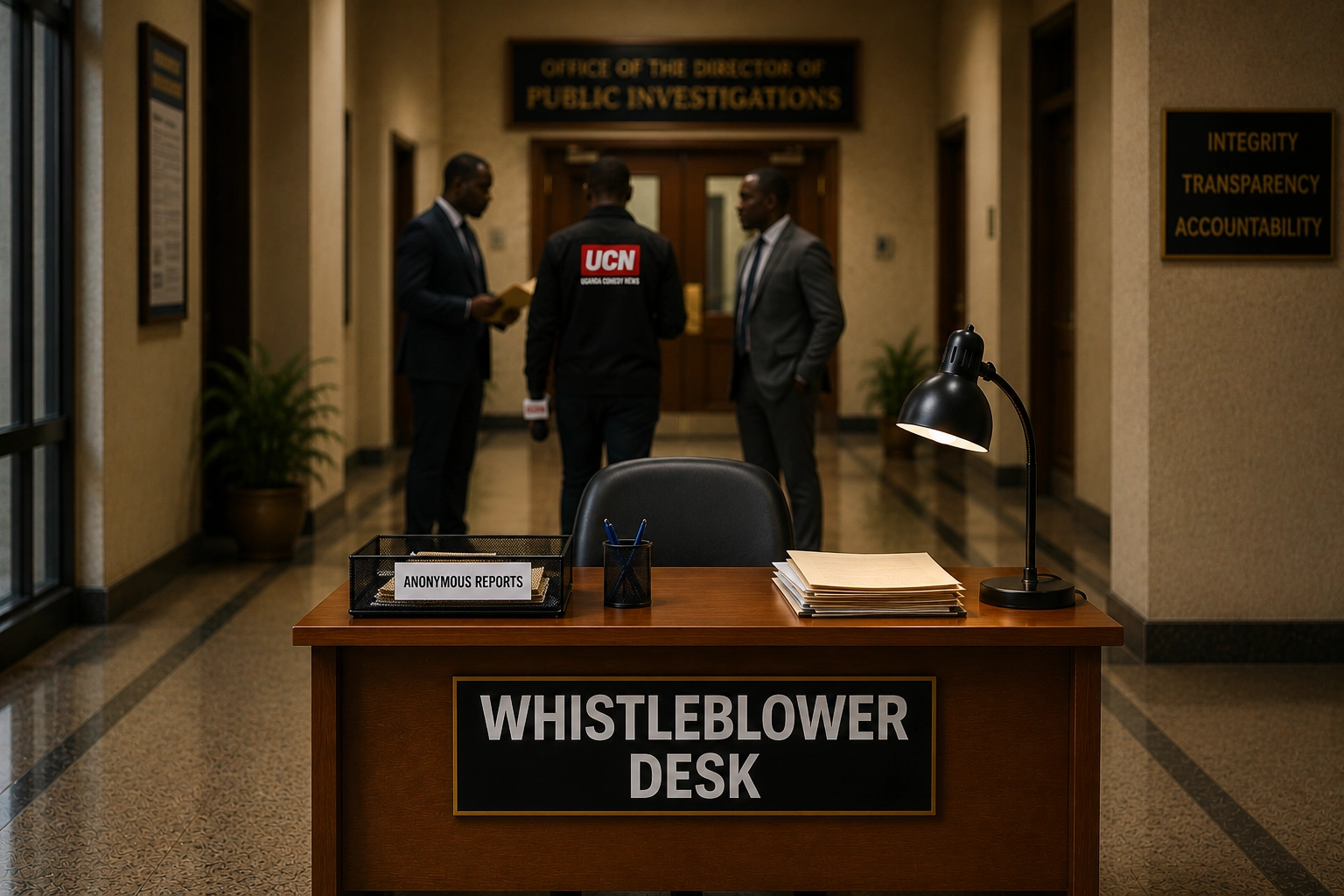
KAMPALA — Following calls by outgoing State Minister for Regional Cooperation John Mulimba for the establishment of a special whistleblower desk to support ongoing anti-corruption investigations, several Ugandans with unusually strong opinions about anonymity have insisted the idea is unnecessary because they are “not even remotely panicking.”
Mulimba this week called for a dedicated reporting office where individuals could safely share information regarding alleged misconduct surrounding former parliamentary leadership, urging Gen. Muhoozi Kainerugaba to create a secure space where people can freely volunteer information without fear.
The call comes amid the ongoing Operation Usifadi investigations, which have reportedly extended to residences linked to former Speaker Anita Among, including activity in Nakasero, Munyonyo, and Parliament offices.
However, speaking to Uganda Comedy News (UCN), multiple anonymous individuals who repeatedly clarified they were “extremely calm” said the proposed desk would only create unnecessary anxiety for innocent people.
“Why do we need a desk?” asked an unreliable government source speaking on condition of anonymity while carefully shredding documents. “If someone has information, they should first ask themselves whether sharing it is really necessary.”
Another anonymous source, who appeared deeply offended by the suggestion that anyone might be nervous, dismissed the proposal entirely.
“This culture of reporting people is becoming too much,” the source said. “Today it’s a whistleblower desk. Tomorrow people are reporting who bought what, where, and with which convoy.”
The spokesperson of the Uganda Corrupt Anonymous (UCA), also speaking anonymously despite insisting anonymity was unnecessary, said calm Ugandans deserve representation too.
“We are relaxed,” the spokesperson told UCN. “Very relaxed. We are only speaking because this desk idea feels emotionally aggressive.”
According to sources familiar with the matter, though not necessarily the facts, some potentially affected individuals have privately expressed concern about how accessible such a desk might be.
“What if it has chairs?” one anonymous source reportedly asked. “That encourages people to stay longer.”
Another source was reportedly concerned about Mulimba’s use of the phrase “opening Pandora’s box.”
“Pandora’s box suggests contents,” the source said. “That kind of language can unnecessarily disturb peaceful citizens.”
A Kampala resident following the developments said the desk risked making innocent people uncomfortable.
“Even if you’ve done nothing wrong, just seeing people confidently entering such an office can disturb your peace,” he explained.
Dr. Noah Kiggundu, a political psychologist who spoke to Uganda Comedy News, said public overconfidence during investigations is psychologically revealing.
“When individuals repeatedly insist they are calm, unbothered, and fully supportive of transparency without being directly accused of anything, that itself becomes interesting,” he explained.
Meanwhile, an office desk believed to be under informal consideration for whistleblower duties welcomed the proposal.
“I am structurally prepared,” the desk allegedly said through sources our reporter did not verify. “Bring files, anonymous notes, or emotionally charged envelopes.”
By press time, several outspoken opponents of the proposed desk had reportedly begun privately asking whether anonymous whistleblowers can be traced through CCTV footage, fingerprints, handwriting analysis, deleted WhatsApp chats, or “those computer things.”
Speaking to UCN, a self-described cyber forensic expert who insisted on being paid consultation fees before answering said tracing anonymous whistleblowers was “technically possible, emotionally satisfying, but heavily dependent on budget.”
“If someone writes a letter, we can examine handwriting. If they use email, maybe metadata. If they use WhatsApp, we first need prayers,” the expert explained. “Nothing is impossible if the invoice is respected.”
KAMPALA — Members of Uganda’s broader corruption community have dismissed calls for a special whistleblower desk to support ongoing anti-corruption investigations, insisting they remain calm, organized, and entirely unthreatened by recent developments.
The reaction follows calls by outgoing State Minister for Regional Cooperation John Mulimba, who urged Gen. Muhoozi Kainerugaba to establish a dedicated whistleblower desk where MPs and other individuals could safely share information relating to the widening anti-corruption probe involving former parliamentary leadership.
Mulimba argued that many people possess useful information but fear speaking openly, describing the initiative as necessary to “open Pandora’s box” amid the ongoing Operation Usifadi investigations, which have reportedly extended to properties linked to former Speaker Anita Among in Nakasero, Munyonyo, and Parliament.
But speaking to Uganda Comedy News (UCN), the corruption community appeared largely unimpressed.
“We wish to assure the public that we are not panicking,” said the anonymous spokesperson for the Corrupt Citizenry Desk (CCD).
“A desk is just furniture. What needs to be communicated is who will be manning it so that we see how to work with them. I mean, what if it has chairs?” the source reportedly asked. “That encourages people to stay longer and talk more.”
The spokesperson, who spoke on condition of anonymity despite appearing at what looked like a press briefing, dismissed suggestions that whistleblower infrastructure posed any serious threat.
“We have existed through commissions, investigations, audits, leaked reports, task forces, angry radio talk shows, and motivational anti-corruption speeches,” the spokesperson said. “Respectfully, this is not our first desk.”
According to an unreliable government source, some members of the corrupt community were initially confused by the proposal, believing it might be another office furniture procurement opportunity. “Once they understood it was for reporting, interest reduced slightly,” the source explained.
A former corrupt veteran, Sam Gumitte, following the developments said the desk risked making innocent people uncomfortable. “Even if you’ve done nothing wrong, just seeing people confidently entering such an office can disturb your peace,” he explained.
Dr. Noah Kiggundu, a political psychologist who spoke to Uganda Comedy News, said overconfidence during investigations is psychologically revealing. When individuals repeatedly insist they are calm, unbothered, and fully supportive of transparency without being directly accused of anything”, he explained. However, when a system has survived repeated anti-corruption enthusiasm cycles, participants may develop institutional resilience, he added.
Meanwhile, the whistleblower desk itself welcomed the challenge. “I am structurally prepared,” the desk allegedly said through sources our reporter did not verify. “Bring files, anonymous notes, or emotionally charged envelopes.”
By press time, members of the corruption community had reportedly begun privately asking whether anonymous whistleblowers can be traced through CCTV footage, handwriting analysis, deleted WhatsApp chats, or “those computer things.”
A self-described cyber forensic expert who spoke to UCN said tracing such individuals was theoretically possible.
“Technically yes,” he explained. “Morally questionable, but technically yes. Budget permitting.”